
Real estate in desirable locations is naturally scarce and expensive.
Expanding cities by further horizontal sprawl has myriad disadvantages, starting with the need for a lot of ugly infrastructure, and dilution of the benefits of proximity, which are the reason people seek real estate in big cities to begin with. When you build out, it’s farther away. Simple as.
The solution if obviously going vertical. However, building up has its own disadvantages, including tall buildings being inexplicably unpopular with many municipalities and inhabitants. Hurr durr concrete jungle etc.
But the vertical axis has two directions. In addition to the traditional approaches of building out and building up, let me suggest an underexplored and potentially highly beneficial move - building down. Move a bunch of stuff underground!
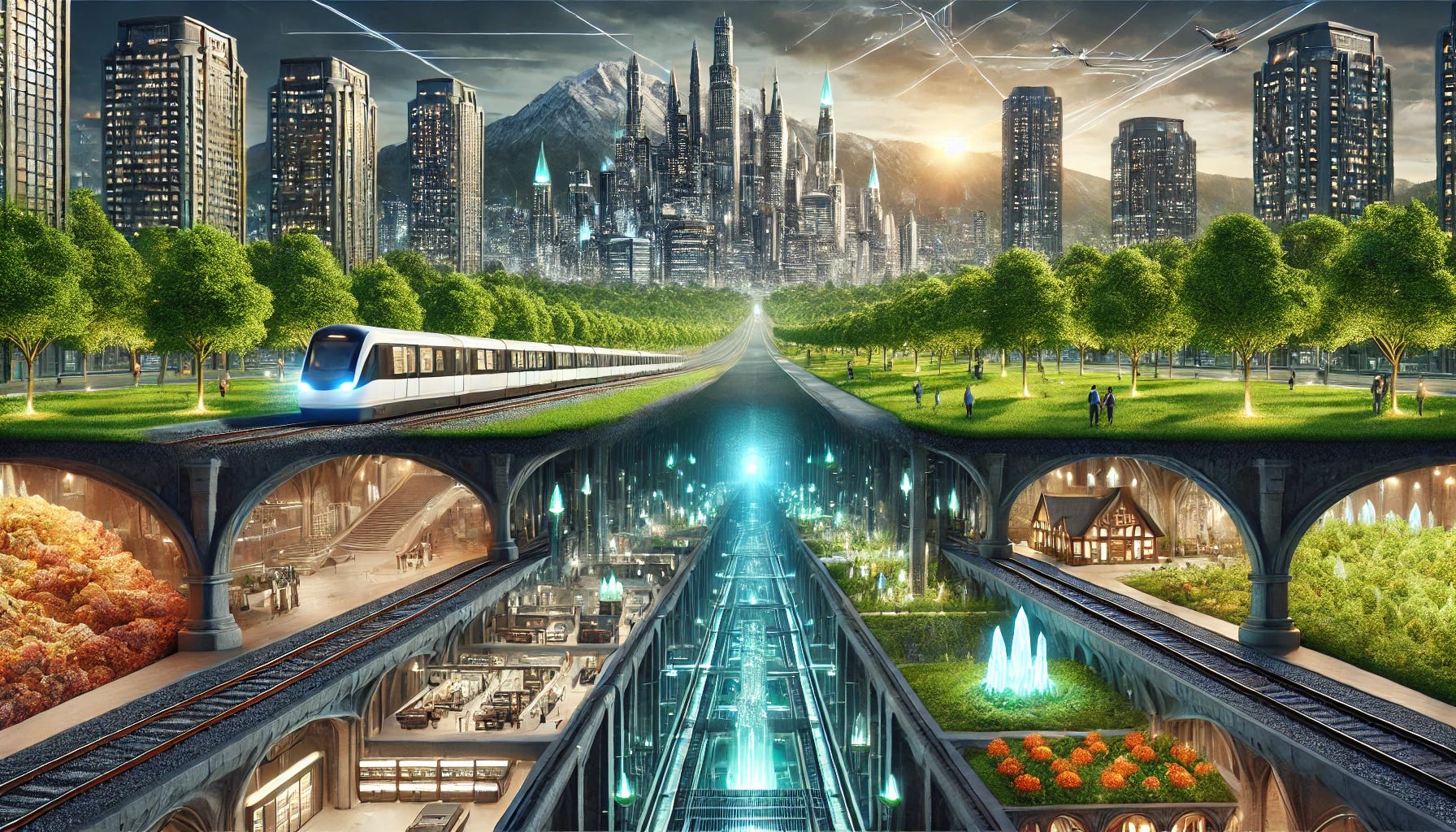
The obvious candidates are everything too ugly or dirty for the surface - starting with transportation infrastructure. Boring Company is already doing God’s Elon’s work on this front, a good start, but there’s so much more we can do: utilities, shopping, storage, factories, basically all infrastructure. Leave the surface for living and enjoyment, move all the functional bits underground.
Contra the various green-red types, whose criteria for good urbanism boil down to “looks nice from the window of my favourite café while I do my fake email job on a macbook with weird social cause stickers on it”, the unsightly infrastructure is really necessary, and there's no way around it, nor to make it anything else than marginally less ugly. Freeways, parking lots, shopping malls and vast warehouses are actually necessary for a city to work.
But they can be out of sight, underground. We can build cities like icebergs - with most, or at least a substantial fraction of the volume under the surface.
The ideal Iceberg City of the future is therefore a walkable, leafy green utopia on the surface, with vast sprawling infrastructure bowels going deep underground, with all the useful stuff keeping the city running - high speed rail, subways, utility grids, waste management, retail and commercial zones, storage, logistics and distribution, data centers (cooled by the stable, ambient low temperature underground). Add also underground farms (above ground vertical farms in expensive cities are economically nonsensical PR stunts), including mushroom farms to provide much of the city’s food supply locally, utilizing the city’s own biowaste - how’s that for a circular calorie economy?
Additional benefits of building underground include protection from elements, natural disasters (including earthquakes, which are mostly surface phenomena) and terrorist / military attacks.
This post is not sponsored, but should be, by Bethesda’s Fallout Shelter.
The concept is superficially similar, but functionally in stark contrast to what the walkable fifteen minute city types want, which literally wouldn’t work on the most fundamental physical, logistical level, and which reflects their own uselessness - they can’t even imagine that some people need to move around to be somewhere on time, unsweaty and unsmelly, and do useful things, often involving loads that cannot fit on a bicycle, or segway, or e-scooter, or whatever the latest fashionable children’s toy unwisely allowed to complicate traffic and entitledly endanger pedestrians is.
The Iceberg City is almost but not quite like what they are proposing, but in a way that can actually work. We can have our cake of aesthetically pleasing cities, and eat it and have functional, efficient, high capacity infrastructure too.
I am realistic, and realize Iceberg Cities are not without challenges and difficult preconditions. In addition to the fundamental challenges of engineering and cost, there are additional political problems of planning, overregulation and vast municipal corruption, all contributing to infrastructure costs being even vastly higher than they strictly have to be on purely technical and first-principle (under)grounds.
There are psychological factors, too. To be comfortable for humans, the aesthetics of these undeground spaces will be extremely important. Making them utilitarian and industrial might rub a lot of people the wrong way, but maybe tastefully leaning into fantasy elements might help - welcome to Khazad Dum, minus the Balrog. American Art Deco meets Mines of Moria. Make it spacious, grand and impressive (think old European subway stations on steroids), incorporate underground greenery and plenty of light. You get the idea. Make it nice.
Safety and ventilation are clearly considerable issues, but manageable.
I acknowledge all of those challenges, but consider the benefits.
You have efficient, fast transit that doesn’t sully the aesthetics in any way. With Boring Company type tunnels for cars, or a derivative with private pods, you don’t have to worry about any Victims of Socioeconomic Factors (no such thing, btw) yelling, catcalling, fondling, pickpocketting, stabbing or vomiting on you on your commute. Leafy streets and plazas combat urban heat island issues and improve wellbeing and mental health. Everything works, everything and everyone is smoothly and efficiently where they need to be on time, but you live in a big park. Rivendell in the streets, Moria in the sheets.
The proposal may seem outlandish, but I argue that it is actually our current way of building cities that is insane, and will obviously be perceived as such in retrospect, after building underground becomes the new normal.
The way we build cities now, with essential infrastructure exposed, is akin to wearing our intestines, kidneys, and blood vessels on the outside of our bodies. These vital systems belong inside, protected and efficient, much like our cities' infrastructure should be inside the earth. Organs belong inside the skin, infrastructure belongs underground.
While it might be politically fraught and smell of stowing away the plebeians in the basement, it’s also possible to build underground housing, provided perfect air conditioning, artificial daylight for all the circadian stuff, and utterly convincing programmable fake windows - it can subjectively be your own villa on the Gulf of Saint Tropez, actually 300 meters under San Francisco. Yeah yeah, basement dweller dystopia morlocks mole people yada yada, but it cannot possibly be more expensive or dystopian than 2024 surface San Francisco. NIMBYs gonna have a hard time objecting to things that don’t spoil their views, although they will certainly, as usual, find an angle to problematize anything that might benefit anyone else in any way whatsoever.
Who might do this first? Stable low underground temperature is an especially compelling argument for Iceberg Cities in places too cold or hot to comfortably inhabit for much of the year - paired with the preconditions of having money for wild moonshot projects like this, a high degree of freedom and authority in decisionmaking, and exorbitant real estate prices economically justifying significant investment in underground expansion, obvious candidates include notably Dubai, Saudi Arabia, Qatar, but also perhaps Las Vegas. These, and others like them, might be the first to undertake pilot projects. As already mentioned, it’s also a very useful feature for data centers, the need for which is clearly going exponential, and I’m suprised Big Tech isn’t hollowing out mountains instead of building big boxes in the desert yet - especially if the data center is of strategic importance (think AI), and likely to catch a tactical nuke in the event of an international misunderstanding.
In any event, we need to get much better at subterranean construction anyway for a bunch of reasons, including as practice for space colonies - for which Iceberg Cities can be fertile testing and development grounds, with simultaneous backpropagation of space tech to improve life on Earth. Once we have cheap and fast excavation and underground construction, why would you not apply it to make cities on Earth better?
I trust you are aware of the NEOM project .... https://www.neom.com/en-us/regions/theline