
An aesthetic hate crime is being perpetuated against ancient humans and I’m here to fix that.
#CromagnonLivesMatter
When you look at any and all depictions of prehistoric humans, they’re usually loincloth-clad rockbangers living in dismal huts made of grass and dung. But even among present day hunter-gatherers, that is basically never the case. Almost every existing hunter gatherer tribe is rizzed up the nose - look at e.g. Papuans, who in their level and variety of ornamentation are the human equivalent of birds of paradise.
It’s therefore safe to assume ancient humans were pretty far from club-and-leopard-skin troglodytes, and were in fact probably sporting serious swag. The simple assumption is that the Veblenist instict to ornametation is fundamental to human nature, and craftsmen who spent their entire lives perfecting their trade were probably pretty good at it.
This makes most existing depictions and reconstructions of paleolithic and neolithic culture disinformation.
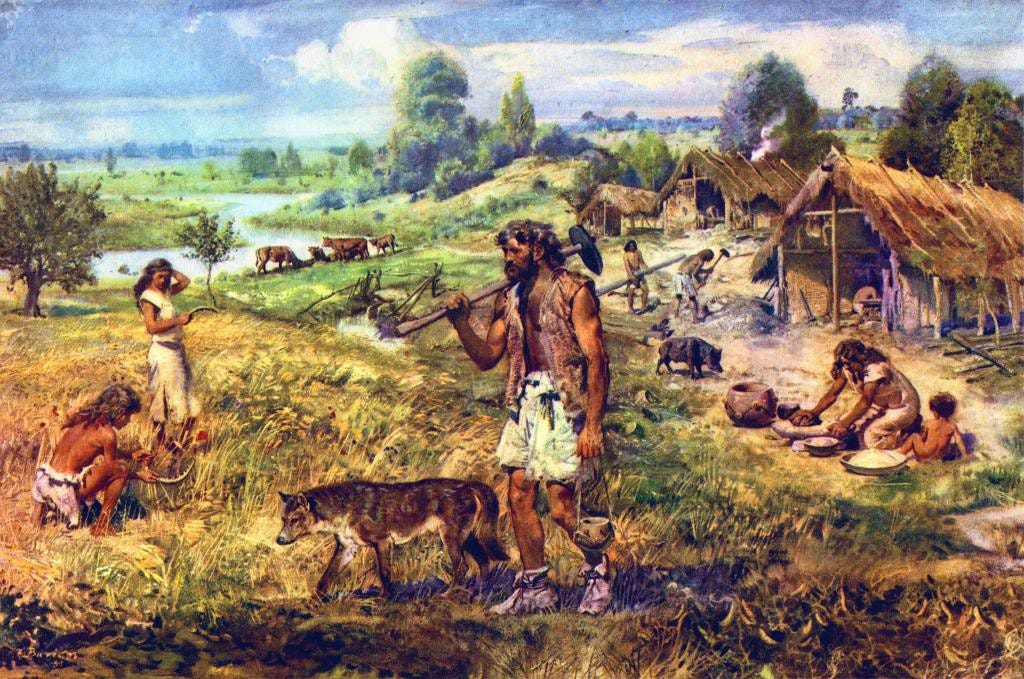
A special category of offender are open air museums with “reconstructed” dwellings, which usually look like this:
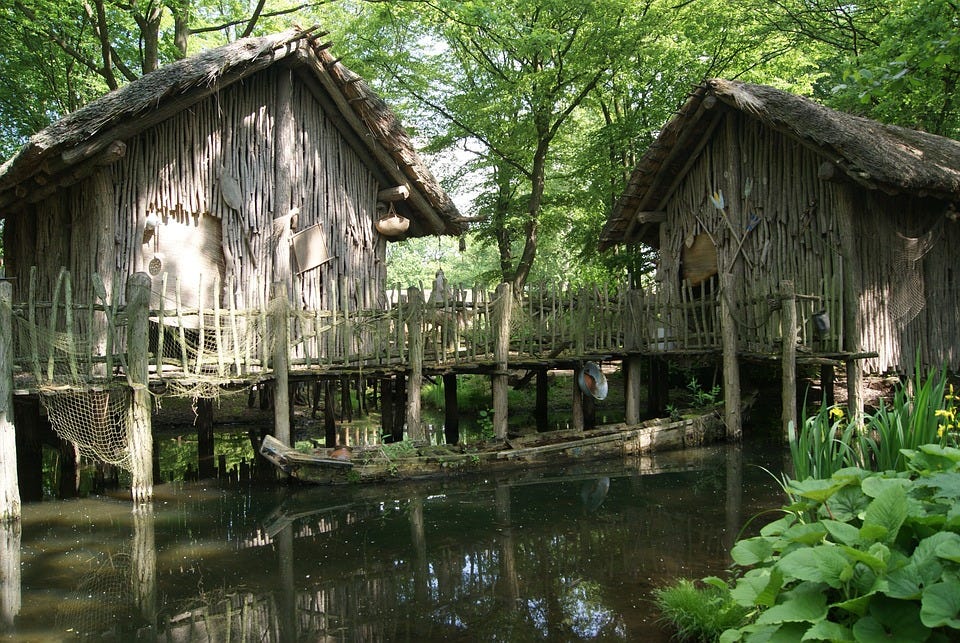
Even 40,000 years ago, no craftsman would have dared deliver that. Any amateur today can do 1000 times better.
On the other hand, honorable mention of the Unteruhldingen museum on Lake Constance. Bonus points for “Unteruhldingen” meaning “Lower Owl-ville”. Pictures copyrighted but check it out here. I maintain it would have been even nicer than that, and far earlier, but kudos for moving at least a bit in the right direction.
Why does it usually look like shit?
Chauvinism - academics tend to assume that even most people today are retarded rockbangers, so depicting anatomically modern humans in the past as skilless, artless untermenschen living in piles of failsticks in a swamp somewhere is consistent with their entire worldview, and a telling Freudian slip. An unexamined remnant of 19th century self-congratulatory supremacism capable of depicting all Others only in humiliating caricature, á la blacks in physiognomy textbooks.
Archaeology grad students are bad at manual labor, in fact they may be among the least manually skilled people in the world, and when holding a hammer for the first time in their life, they shortsell the skill of ancient craftsmen and artisans, who would have spent a lifetime perfecting their trades.
They don’t want the reconstructions to be potentially misleading via excessive artistic licence, and choose to err on the side of simplicity (to which they add idiosyncratic shoddiness as per the previous point), and omit rather than add. This is the only slightly good reason, especially when you know how many liberties Evans took with the “reconstruction” of Knossos. Basically, they don’t want to get too creative, even though it’s super likely ancient people were.
(Archaeological parks, besides being aesthetic misinformation, are also typically intended more or less to steal grants, so low effort work leaves more for the project lead / PhD supervisor / department head to defraud)
It’s useful to realize what the reconstructions are based on - we know there were X post holes in the ground, we know the outline of the building and can infer from that how robust it roughly could have been, but we have no way to know whether it looked like Clumsy Heinrich the soylent PhD’s shitbarn above, or Elrond’s Rivendell. It’s conjecture, and they choose very unflattering assumptions.
However, if we assume constant human nature and intelligence, which at the scale of tens to low hundreds of thousands of years we safely can, then it was more likely Rivendell. This assumes nothing else than “people always liked nice things and showing off, and were capable of becoming skilled”.
My radical theory is that professional builders, carpenters, woodworkers, jewelers, weavers and tailors* were better at their jobs than archaeology students holding a hammer, non-butter knife or needle for the first time in their life.
Huge if true.
This is relevant to ice age civilizations discourse, because there’s a sort of false dichotomy whether people were sitting around a campfire making grunting noises or if they were at the level of the Bronze Age / Rome / early modernity (choose your prefered level of schizo). The debate is instantly moot when we introduce the possibility of an advanced stone age culture.
For supporting evidence, look at the level of precision and control achieved in stone tools tens of thousands of years ago. You think they only got good at this one thing? Lol.
Look at this Kiribati armor made of coconut and shark bits.

This is stone age technology plus crafstmanship, and the only way stuff like this wasn’t around for tens of thousands of years would be if people somehow only became capable of crafstmanship recently. How likely is that?
People who should know better tend to conflate advancement on the stone-copper-bronze-iron-steam-internet temporal axis with sophistication, but those are (largely) orthogonal.
So the unspoken assumption revealed in reconstructions and depictions of ancient life is “nothing nice could have been made out of stone and wood”. But in Gobekli Tepe, we have conclusive proof people were good with stone much earlier than previously believed, and there is no reason why that would be different for wood (which is easier to work with!). For things you can do with wood without advanced technology, check out the insane feats of Japanese joinery.
In conclusion, I hope we pull out a fully preserved Rivendell cottage from a bog and then go collectively laugh at the “reconstructed” shitbarns.

It was probably (almost) like this for tens of thousands of years.
Objections and answers:
It assumes fairly robust specialization and division of labor.

It’s common for hunter-gatherer communities today to sustain dedicated craftsmen, and for the hunters to have second jobs and hobbies. This isn’t controversial.
Advanced crafts are a product of idle winters when people have more time to git gut, which is more a sedentary agriculturalist thing than a hunter-gatherer one.
1) But permanent and semi-permanent settlements and cult sites were a thing long before agriculture.
2) There was plenty of time between hunts to hang around doing your hair, carving thicc pawgs out of mammoth ivory and pimping up your hut.
3) You always had people hanging around the camp more or less full time - women, the old, decomissioned injured hunters, priests and shamans. The latter are perhaps especially relevant, as the craftsman-priest dual class is fairly well attested across cultures (e.g. the blacksmith among Indo-Europeans, the weaver/seamstress of fates á la Norns and Morai, or a certain miracleworking carpenter of later fame) and much art would have carried ritual significance and required a priestly hand. This is common to this day in e.g. Shinto, which is the closest thing to surviving complex animism.
4) Level of crafting proficiency improved bargaining power in whatever barter economy there was, both within the tribe and between tribes (even long distance trade networks are old), so you have a profit motive as well.
Or we can insanely continue assuming that nobody was good at specialized crafts, and that people ignored how effective ornamentation and elaborateness (“peacocking”) is for signaling and obtaining social status and sex. Yeah that sounds plausible.

* There is evidence of woven fabrics from Dolni Vestonice (present day Czech republic) 28 000 years ago (!!!11!oneone!!). The site was a massive trade nexus in a narrow isthmus between the northern ice sheet and the Alps, sitting below a mountain overlooking the only passable inland route between Western Europe and the rest of Eurasia.


Since the local material culture was the customary Gravettian mammoth tusk huts (but nice pimped up ones!), the climate wasn’t favorable to flax or hemp and sheep were not yet domesticated (probably), the fabrics were almost certainly imported. If Georgian archeologists are to be believed (a big “if”), a possible source is the culture associated with Dzudzuana cave in Georgia, where spun and worked flax fibers, dyed pink, turqoise, gray and black, were allegedly discovered, dating from 30 000 years ago. I’d be curious about the chemical composition of the dyes, especially if the turqoise was really turqoise, i.e. the mineral from Iran, pointing again to an extensive trans-eurasian trade network, a prehistoric “Silk Road”. It’s also interesting, though possibly random, that the threads were found in Georgia, or Colchis, of Golden Fleece fame - maybe the place’s reputation for sick threads goes way back. Oral tradition lasting tens of thousands of years would be exceptional, but not unprecedented.
Ok, so woven clothes in vivid colors in the Upper Paleolithic. So much for leopard loincloths.
TLDR we know nothing and archaeology is just getting started.